When Words Aren't Available, Healing Still Happens
Recently, during a Basic TFT Algorithm Training, I had a profound experience helping someone work through a traumatic event that had happened more than 30 years ago.

This was a standard
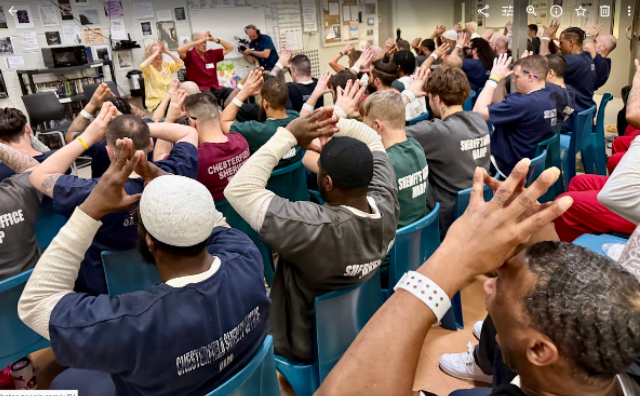
Thought Field Therapy (TFT) training from 9:00 a.m. to 5:00 p.m., teaching participants how to use tapping algorithms. There were
24 participants, almost all trained, experienced mental health professionals.
With TFT, we practice what we learn by working with each other on real issues. One of the beautiful things about TFT is that you don’t have to disclose or share details of what you're working on, just a general category is enough. Knowing whether it’s traumatic stress from the past or a phobic response in the present is sufficient to guide us to an effective tapping pattern.
Another helpful — but not required — element is a Subjective Units of Distress (SUD) rating.
When Feelings are Hard to Access
Sometimes, accessing sensations in the body to identify an emotion can be difficult, especially for those who’ve learned to dissociate or compartmentalize feelings.
One woman in the group was open to feeling her emotions, but rating their intensity was hard for her even when she knew or suspected that what she was thinking about was deeply affecting her.
She was a survivor of the Rwandan genocide, which occurred when she was ten years old. She suspected that her difficulty with feelings was connected to that experience.
During the morning session, she was able to participate fully, helping others and exploring safe, accessible issues in her own life.
TFT allows us to work even without a SUD score, which made that possible.
A Museum, a Memory, and a Trigger
The training was held at the Dallas Holocaust and Human Rights Museum. During the lunch break, participants were invited to tour the museum, which includes a powerful exhibit on the Rwandan genocide. Some of her colleagues later shared that she had been visibly triggered by the exhibit.
After lunch, our training resumed with a discussion of more advanced TFT techniques, including muscle testing to guide the tapping sequence. Normally, this segment lasts about 10–15 minutes, and participants simply observe as I work with a volunteer, without going into full detail on the advanced protocols.
At my invitation, she came to the front of the room. We began muscle testing as she quietly focused on what had happened in Rwanda. We quickly arrived at a tapping pattern that appeared to help.
She visibly relaxed. Her breathing deepened, her facial expression softened, and her body grew less rigid. This took only about three minutes.
A Shift in the Field
She reported that something had shifted and agreed to continue. When I asked her to think again about what had happened, she asked for clarification. I suggested she focus on whatever part felt most difficult.
She immediately nodded — she was there in her thoughts.
We again used advanced TFT techniques, letting her body and inner wisdom guide us to a new tapping sequence that brought immediate relief. She became much more present in the room and then, gently, chose to share what she had been working on.
A Child's Guilt, a Woman's Release
She explained that she had carried deep guilt and responsibility for the murder of her younger brother. She had been the last to see him alive and had always believed his death was her fault because she didn’t protect him.
In her mind, had she dressed him as a girl, he might have lived. They were killing males and letting females live.
That ten-year-old part of her had carried unspeakable shame, so much so that she had never told anyone, not even in therapy. The adult part of her knew it wasn’t her fault, but the younger part still believed she was to blame. She had hidden these feelings not only from others but also from herself.
I asked if she had ever explored these feelings with her family or in therapy. She said she had never shared this before in her life.
She spoke with clarity and ease. She even agreed to begin sharing these thoughts and feelings with her family. We briefly touched on the importance of staying connected to feelings and bodily sensations while doing this work.
Then we transitioned back to the next part of the workshop which was returning to learning and practicing TFT algorithms.
Her willingness to allow me to help her, even in this brief way, was deeply moving.
Honoring Generational Healing
Fifty years ago, when I met my wife, I had never even heard of the Armenian genocide. Over time, I grew close to her grandmother, who had survived that genocide at age fifteen, after witnessing her family’s murder and being forced on a death march across the desert to Syria.
It’s common for families and communities to avoid speaking of such horrors. Generational silence becomes its own trauma. Her grandmother rarely broke that silence. I’ve always regretted not being able to help her more.
So now, when I have the opportunity to assist a genocide survivor, I do it to honor Grandma, and to honor all those who’ve suffered alone or in silence.
Final Reflection
Never let the absence of words — or a missing SUD score — stop you from helping.
Healing can happen in silence, too.
About the Author
Robert L. Bray, PhD, DCEP is a seasoned clinician, trainer, and leader in Thought Field Therapy (TFT) and trauma recovery. He operates the TFT Center in San Diego, California, where he maintains a thriving private practice. Dr. Bray leads TFT trainings and teaches crisis intervention, critical incident management, self-care, and experiential psychotherapy. A longtime collaborator of TFT founder Roger Callahan, he is the author of Heal Traumatic Stress NOW, a practical guide to resolving traumatic stress and restoring well-being.