Donna Eden, David Feinstein, and Dondi Dahlin Leave the Conference — and Bring Tapping and Energy Medicine to Jail
When Conference Connections Lead to Unexpected Collaboration
One of the many benefits of ACEP Conferences is meeting someone who becomes an important collaborator. Donna and I were already fans of the HARP program (Helping Addicts Recover Progressively) in the Chesterfield County Jail, which has used tapping extensively and brilliantly in reducing recidivism from the national average of 70% down to 23%. But we had never before met Kerri Rhodes, the jail's Director of Behavioral and Mental Health.
Kerri's Invited Presentation at ACEP's 28th International Energy Psychology Conference on how she brought tapping into the jail was as poignant, riveting, and inspirational as any presentation you are likely to experience at any conference in the next decade. She shared her journey as a devastated mother following the death of her loving, outgoing, brilliant son Taylor from an overdose at age 20, and the winding path that led to her groundbreaking work with the jail.
The crushing weight of her grief compressed the foundations of her soul, and a diamond was formed there, one that Kerri has polished into a beacon of hope for thousands.
A Fish Finds its Ocean
Reflecting on the conference, Kerri wrote on Facebook about how much resistance she had faced every step of the way. Those of you who have tried to bring tapping into your local hospital can imagine. She used the metaphor of a fish climbing a tree. But she went on, in a manner that reflects both her humility and her ability to maintain a beginner's mind despite her considerable success:
"This weekend, something shifted. I wasn't a fish climbing a tree. I was a fish in the ocean. My team was in the ocean [two of her staff were also at ACEP]. It felt as though the Universe wrapped its arms around us and said, 'You are exactly where you are supposed to be. Keep going. Keep doing the hard things.' And I cannot fully describe what that felt like.
To spend time with people whose books have sat on my desk, whose ideas have shaped my work, whose courage helped create an entirely new conversation around healing—it was surreal. I got to learn from and talk with people I have admired for years. To be in the same room as Donna Eden, Dr. David Feinstein, and Dondi Dahlin was beyond anything I could have imagined. To have them admire the work I am part of in the jail still blows my mind. For basketball fans, it felt like walking into a gym to shoot hoops and finding Michael Jordan standing beside you asking if he could join the game.
The experience filled my soul in ways I am still trying to process."
From the ACEP Conference to the HARP Program
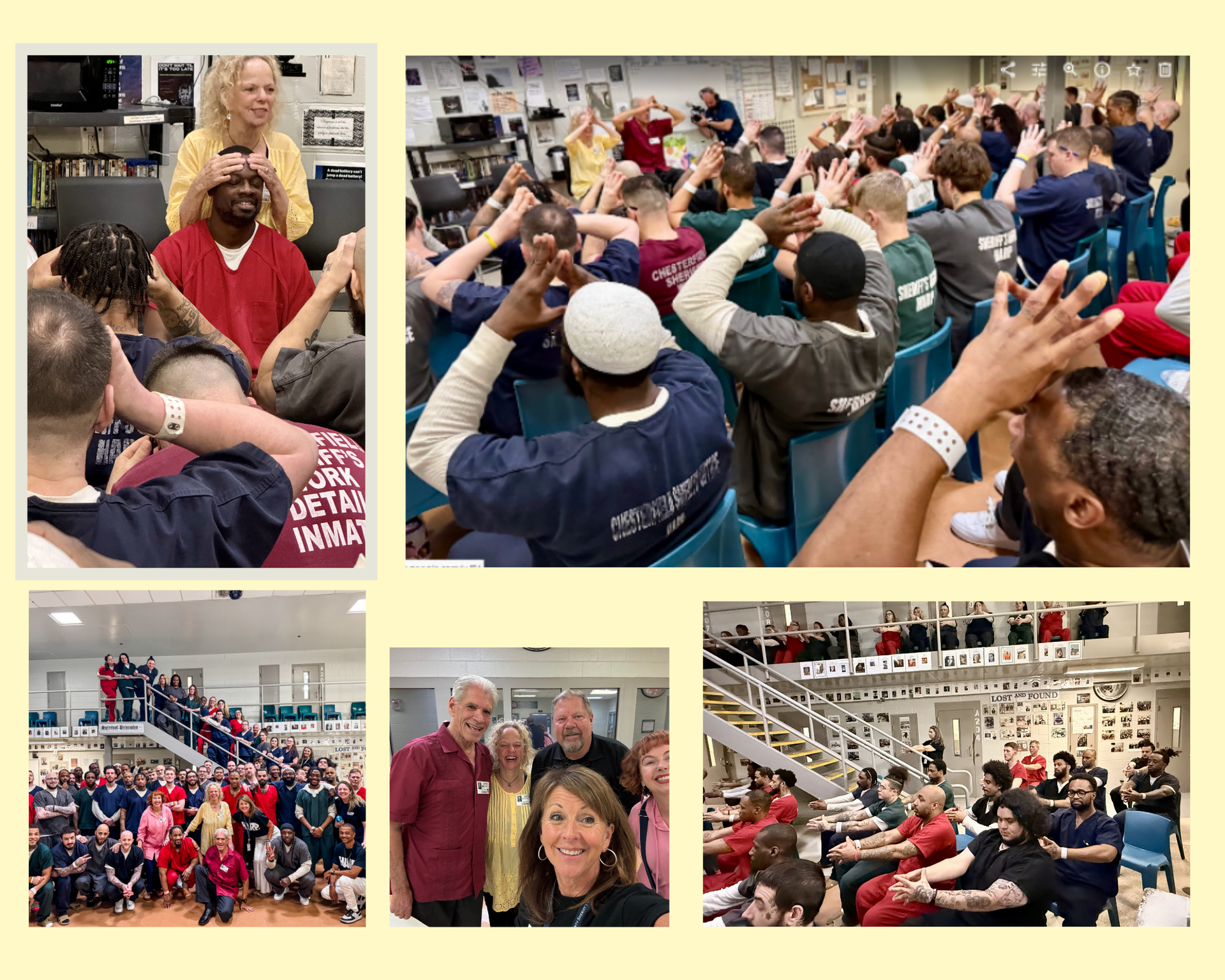
After meeting, Kerri invited us to make a presentation at the jail. We accepted and visited the week after the conference.
We had presented in jails before and described a familiar beginning:
"A guard escorts you through one heavy door to a small passageway. It slams shut behind you. Then the next heavy door opens. Finally, to the door behind which a large roomful of seated participants, men and women, were packed in and waiting."
But this visit was different.
"That's the moment it changed. We were met with enthusiastic applause, cheers, smiles, and appreciation. And we hadn't yet done a thing (Kerri must have said something nice about us). The next several hours were amazing."
Later, we described the experience to our staff:
"The group had many men you wouldn't want to meet in a dark alley supporting one another with a combination of soft sensitivity, unflinching honesty, grounded compassion, and teary eyes that were a cognitive jolt coming from the same large, muscular, heavily tattooed bodies.
The HARP program has created a culture that brings out each participant's humanity, dignity, vulnerability, and self-respect, whereas the stark defensive instincts of survival are more prominent in most jails where we’ve made presentations."
Energy Medicine in Action
For several hours, the group eagerly absorbed every Energy Medicine technique we offered.
One memorable demonstration involved two of the tougher looking men from the group. Both initially energy-tested strong. The larger man was then instructed to direct his gaze down one of the major energy pathways of the slightly smaller man. The result was immediate: the energy test showed weakness.
The room was fascinated.
As I explained:
"When we demonstrate this to college football players, they want to know how to do this to the other team. But that's not what we teach. We teach you how to keep your energies strong so the other team can't mess with them."
We then showed the man whose energies had just been weakened a simple, invisible technique to strengthen his central energy system. The larger participant was asked to try again, this time directing not only his gaze but every aggressive thought he could muster. His face showed that he took the instruction seriously.
The result? The other man's energies didn't budge on the energy test.
"HARP is Better Because They Crossed Our Path"
Kerri later reflected:
"Donna, David and Dondi brought new tools into HARP, and the participants are so hungry for things that give them relief, help them regulate, and help their recovery. Donna and David are such amazing teachers and shared so many great tools with the men and women. There were tears, laughter, and lots of healing in HARP that day. HARP is still talking about it, and they have added the Daily Energy Routine into their morning and evening groups.
It was a combination of light, love and magic.
One of the inmates referred to the 'weird life-changing tools' and another said, 'I thought it was woo-woo' before admitting he is doing the exercises.
HARP is better because they crossed our path."
A Reminder of What's Possible
Stories like this remind us that healing can emerge in unexpected places—and that Energy Psychology and Energy Medicine tools can help foster resilience, self-regulation, dignity, and hope, even in environments where those qualities are often in short supply.
Learn more about ACEP's work advancing Energy Psychology around the world at energypsych.org.
About the Author
David Feinstein, PhD, is a clinical psychologist and has received nine national awards for his books on consciousness and healing. He has served on the faculties of The Johns Hopkins School of Medicine and Antioch College. With his wife, Donna Eden, he directs the world's largest organization offering a highly regarded Energy Medicine Certification Program.
Images provided by Kerri Rhodes